



Do you suffer from cloudy vision due to cataracts, or is poor vision making it hard for you to accomplish simple daily activities? Are you looking for the right cataract surgeon in Tennessee?
At The Regional Eye Center, we offer cataract surgery, safe and effective microsurgery to help you start seeing clearer by bringing the youthful life back into your eyes. New advancements in technology have given patients the opportunity to have even better visual results after cataract surgery through premium lenses.
There are many different procedures, and if you or a loved one is suffering from cataracts, The Regional Eye Center will help you choose the best procedure for your specific situation.
Understanding Cataracts
A cataract is the clouding of the normally clear, natural crystalline lens of the eye. The natural crystalline lens becomes cloudy and yellow over time and will need to be removed with cataract surgery. The sensation of cataracts can be compared to look through wax paper. Many cataract patients will have trouble seeing colors and will have difficulty driving at night. Most cataracts progress slowly over a period of years, but their rate of progression is unpredictable.
Cataract Causes
Cataracts are caused mainly by age, trauma, heredity, and exposure to ultraviolet radiation. Cataracts can also occur as a result of eye disease, after the use of certain medications, or as a result of medical conditions such as diabetes.
- Getting Older – Age is a major cause of developing cataracts.
- A birth defect, like abnormal conditions in the eyes of unborn babies
- Environmental factors such as disease, toxic chemicals, medications
- Accidents or Injuries
- Exposure to ultraviolet light
- Cigarette Smoking

Cataracts Affected Vision
Cataract Surgery
Cataract surgery has existed in this world for over a century, but it is the recent innovations in technology that have transformed this into a very safe and effective surgery. As a patient, it’s great to know that the success rate for cataract surgery is high when you are about to undergo surgery. Cataract surgery is actually the most reimbursed medical surgery by Medicare today! Advanced artificial intraocular lenses inserted during cataract surgery have allowed cataract patients to recover more youthful eyesight.
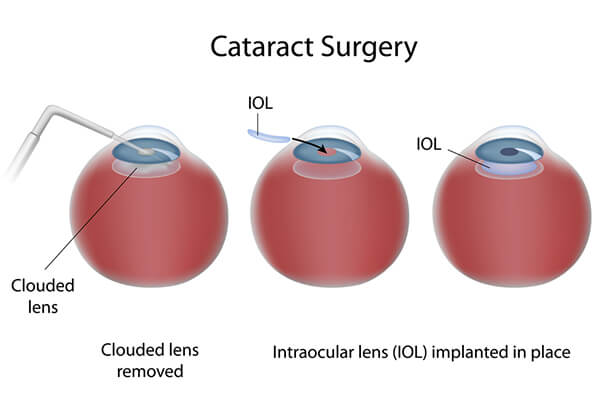
Instead of dealing with glasses after surgery, some patients may have the choice to upgrade to a new premium type of lens that will enable vision at multiple distances. In addition to the new lens implants available, less invasive surgical techniques have come to fruition to enable much faster healing. Despite the effectiveness of the cataract surgery, the preparation process may take weeks and various decisions will need to be made.
The Cataract Surgery Process: Your Tennessee Cataract Surgeons
What happens during cataract surgery?
After the proper anesthesia and numbing of the eye your cataract surgeon will make a small incision in your eye about 3mm wide. Modern-day cataract surgery is also called micro-surgery because the incision sizes have become so small. Once the incision is made the cataract surgeon will insert a probe to break up the cloudy cataract and then remove the material. A suction tube will remove all of the loose debris and the capsular bag previously holding your cataract is prepared for the artificial intraocular lens (IOL) implant.
The foldable IOL is then inserted through a tube and then unfolds once in place. The Intraocular lens will have “lens arms” called haptics to hold it in place. With the cataract removed and the IOL in place, light can once again travel unimpeded to the back of the eye and focus on the retina where the image is interpreted and transmitted to the brain. The end result is a clear, youthful vision.


Are you seeking a Tennessee cataract surgeon? If so please consult our cataract eye doctors at The Regional Eye Center in Kingsport, TN. Our staff and doctors are experienced with cataract surgery and the premium lens implants that are now available for better vision after surgery.